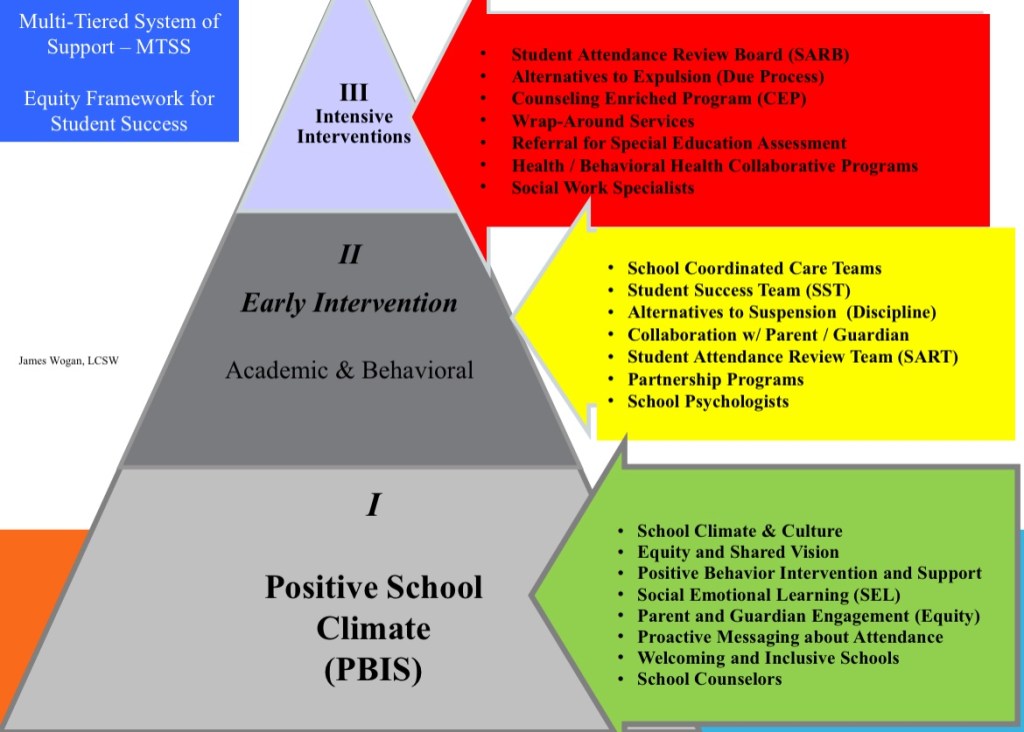
I recently consulted with an agency about School Coordinated Care Teams and the over identification of African-American children in Special Education, known as “Significant Disproportionality.” Utilizing ‘Expanded Equity Partnerships,’ school-based support services are managed and coordinated by School Coordinated Care Teams.
Leaders in this District insist that School Coordinated Care Teams are “MTSS Tier 1.” For example, District says “There’s no point is doing Tier 2 and Tier 3 interventions if schools aren’t doing Tier 1 (PBIS School / Climate) with fidelity.” This misunderstanding is widely held, but only partially accurate. School climate is very important to be sure, but usually not the source of trauma, hardships, and stressors many students face.
Unfortunately, support services are currently stalled out for many under-served students. MTSS was not developed to deny support services to children, but sometimes, this is what plays out.
A rising tide does not lift all boats equally.
Fortunately, we have more opportunities to support kids. Let’s work together on systemic social justice issues, access to behavioral health services, and access to education, i.e. all three tiers concurrently.
I recommended books, Developing your School’s Student Support Teams, Street Data, excellent work of Zaretta Hammond, and publications by West Ed, Break Barriers, and others.
The process of immigrating to a new country and acclimating to a new culture can be simultaneously challenging and rewarding. Leaving family, friends, and familiar surroundings creates uncertainty and anxiety for many recent immigrant and refugee families. At the same time, friendships and positive relationships established soon after arriving in a new county often last a lifetime.
Even immigrants with extensive professional experience in their countries of origin may need assistance to navigate public education and local resources. Many recent immigrant families report they appreciate guidance and support while they’re assimilating to the U.S. Schools and community agencies can be valuable partners as families maintain and uplift their culture and heritage. Celebrate diversity and prepare to learn a lot from people who recently emigrated to the U.S.
I try to avoid the term “newcomer” because it belies the hardships and trauma many students and families have experienced. The term “refugee” in this layperson’s post, means people who fled or were evacuated from their previous country in order to avoid harm, persecution and death.
Not all recent immigrants are legally homeless, however, School Social Workers and others collaborate and offer assistance for recent immigrants families. We serve families who are vulnerable oppressed and living in poverty, regardless of immigration status. (See NASW code of ethics).
It’s the expectation that recent immigrant students will show evidence of the immunizations required to attend school. To support immediate enrollment, school district and child-serving agencies link families with resources with information so they can obtain primary care and immunizations asap.
Contra Costa County Public Health offers free immunizations, for example at the Clinic on Stanwell Circle.
This information is shared with parents and guardians by HOPE, CWA’s, Nurses, and school staff members.
Please note: Homeless report forms are not “applications.” Homeless students are identified by site personnel each school year.
Not all recent immigrants are legally homeless. A student living with a family member in a stable home environment, for example, is not automatically considered homeless. If you have questions, every school district has a Homeless Education Liaison. In addition, County Offices of Education offer support and assistance enrolling and supporting students in school.
“Making a big school districts feel small;” Connect and form partnerships with refugee-serving agencies; this helps families to have a better understanding of how to navigate health care, public education and mental health resources in the U.S. Children are assigned grade level based on age, not language, previous school experience, or current learning levels. Adult Education and Early Childhood programs and classes are offered by region, i.e. persons do not need to meet residency requirements to participate.
For further information and up-to-date guidance, see information and “Dear Colleague” letters from US Dept. of Education, California Department Education, and CDSS
Our shared vision is students smiling and doing well in school.
James Wogan was selected to be a member of CDE’s Student Mental Health Policy Workgroup (SMHPW). The purpose of the distinguished SMHPW is to assess the mental health needs of California students and gather evidence to support policy recommendations to the California State Superintendent of Public Instruction (SPPI) and the California Legislature. This multi-disciplinary workgroup is comprised of teachers, school counselors, school social workers, school psychologists, school nurses, and school administrators, and state and county mental health professionals.
Tiny home village for homeless youth in Oakland / Berkeley. Way to go @YouthSpiritArts Sally and team at #YSA. Thank you for making community better and for giving young people a chance to give back.






 James Wogan LCSW